Skin
AVEYA Snail Mucin Toner Pads: What Is in the Jar, How to Use Them, Who Should Skip Them
The ingredient list name by name, two ways to use a pad, and the people who should pass.
Smile
Two purple strips, thirty minutes, no peroxide. What that means for your teeth, your calendar and your choice of box.
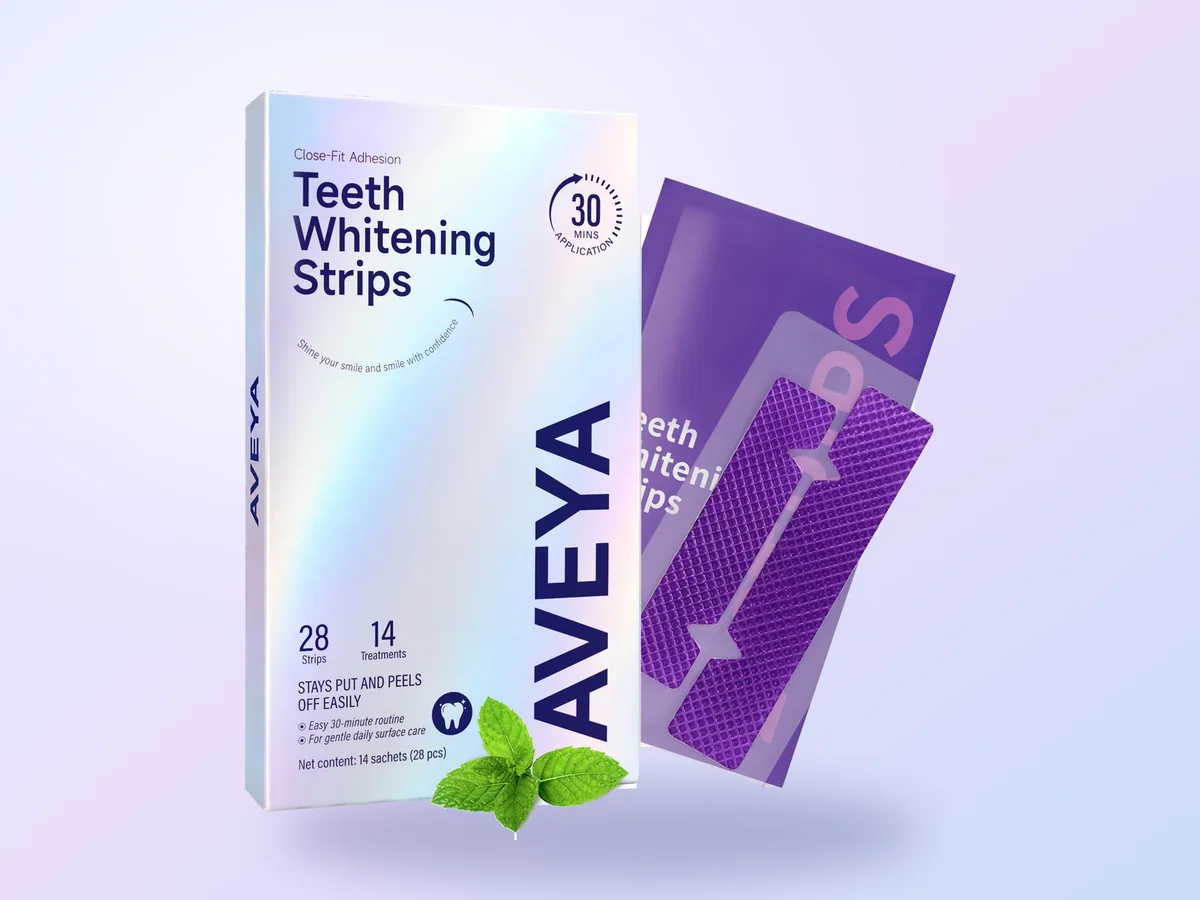
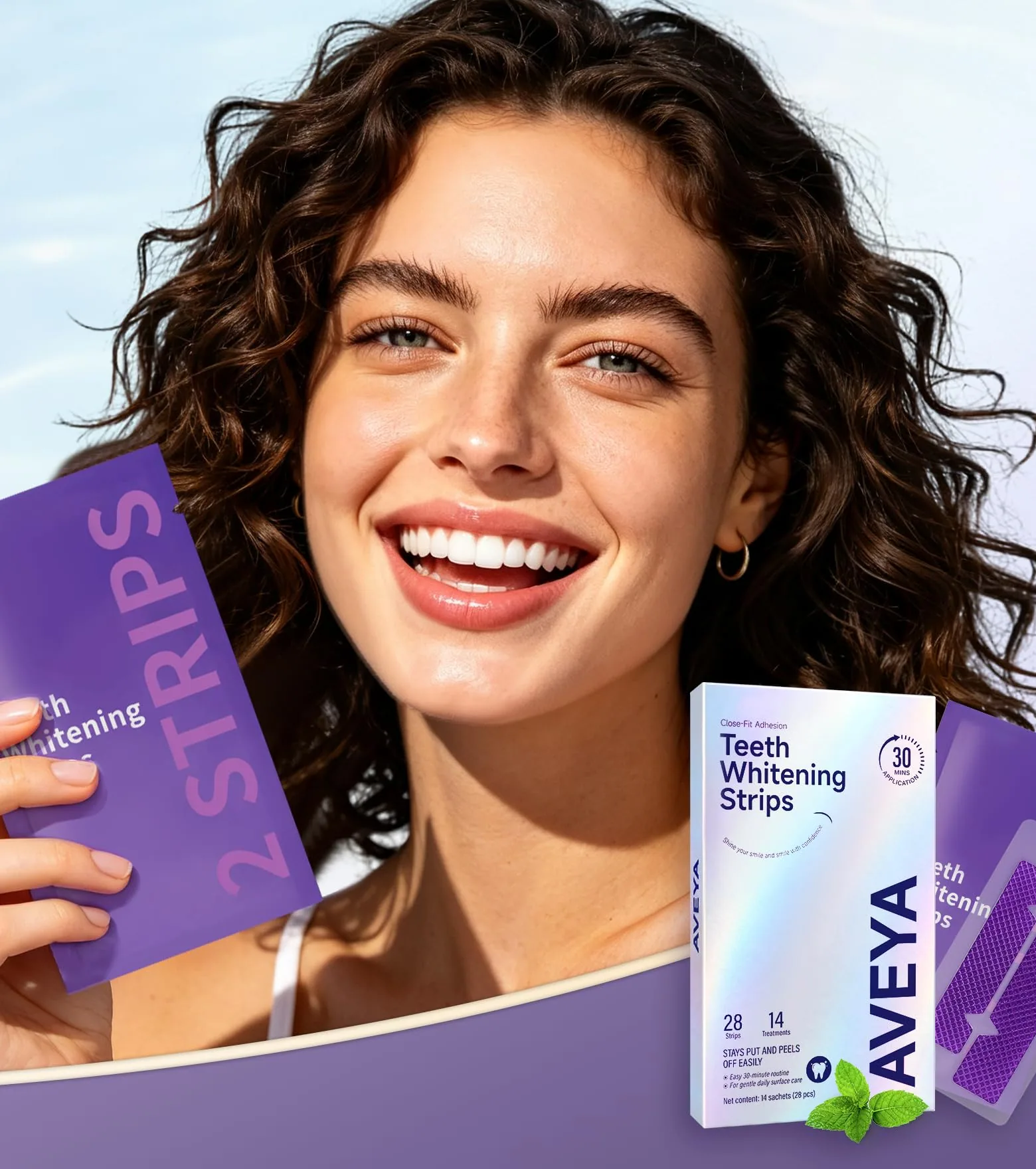
Whitening strips all look alike: a thin film, a gel, half an hour of not talking much. The difference is in the gel. AVEYA Teeth Whitening Strips use PAP where most strips use peroxide. The rest is logistics: 30 minutes a session, 2 strips at a time, and a choice between 28 and 56 strips to a box.
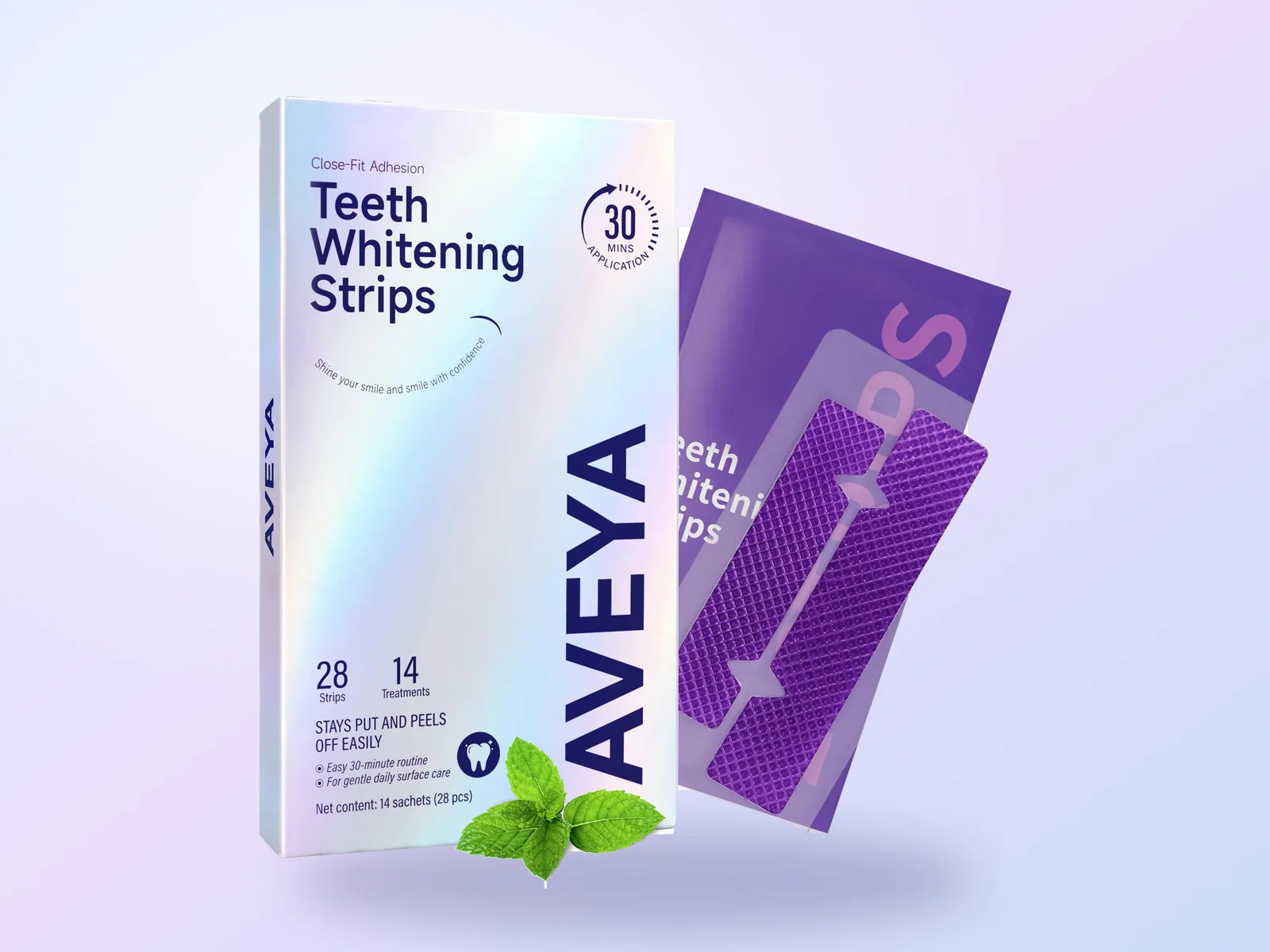
Open the box and you find sachets, not loose strips. Each sachet is sealed and holds 2 strips, one for the upper teeth and one for the lower. One sachet is one session. The small box has 14 sachets and the large one has 28.
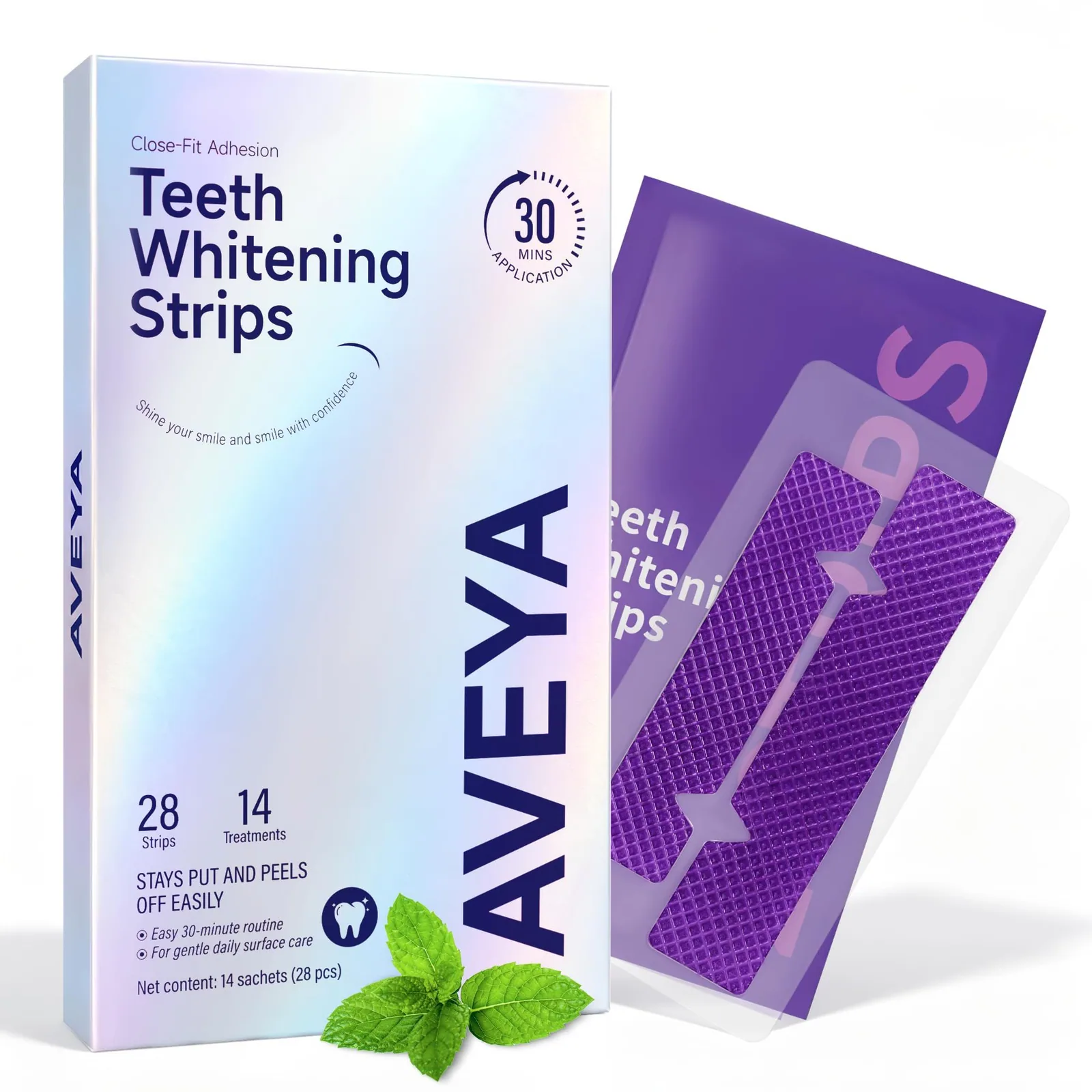
The front of the box is short on words. Close-Fit Adhesion. 30 mins application. Stays put and peels off easily. For gentle daily surface care. The strips themselves are purple with a fine grid pressed into the surface, and the flavor is mint.
Sealed sachets matter for two reasons. A sealed pair stays as it was packed until the day you use it. And a sachet travels: one in a bag is one session away from home.
Every phrase on a box this size has a job. Read in order, they describe the product more plainly than an advertisement would.
| On the box | What it tells you |
|---|---|
| Close-Fit Adhesion | The strip is meant to sit tight against the teeth for the whole session |
| 30 mins application | The wearing time of one session |
| 28 Strips, 14 Treatments | 2 strips make one session |
| Stays put and peels off easily | No rinsing or scraping is expected at the end |
| For gentle daily surface care | The target is the surface of the enamel |
| Net content: 14 sachets (28 pcs) | The strips come in sealed pairs |
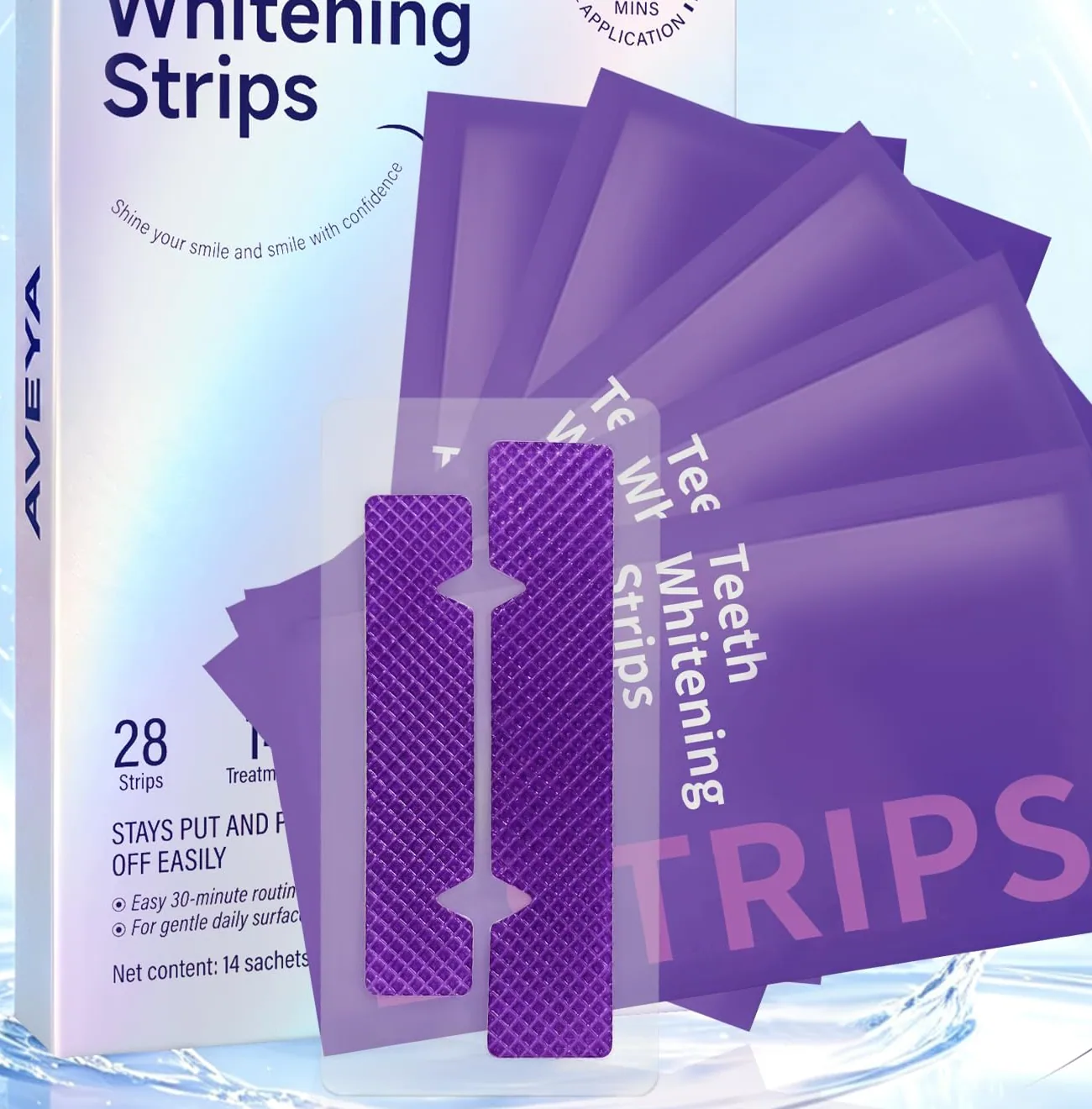
Nothing on the front promises a number of shades. That restraint is worth noticing, because shade promises are the first thing to distrust on any whitening product.
The whitening agent in these strips is PAP. The letters stand for phthalimidoperoxycaproic acid. The pack sets it against the usual ingredients with three zeros: 0 hydrogen peroxide, 0 carbamide peroxide, 0 sodium lauryl sulfate.
To see why that matters, look at what whitening strips usually contain. The American Dental Association is direct about it.
Most whitening strips rely primarily on peroxide to bleach teeth.
Peroxide bleaches. It sets off a chemical reaction that changes the color of the tooth, and it is the ingredient dentists use most. Dental research also links peroxide exposure to the short-lived sensitivity some people get during whitening. PAP strips are for buyers who want to try a different route.
| Ingredient | What it is | What the pack says about it |
|---|---|---|
| PAP | phthalimidoperoxycaproic acid, the whitening agent | Contributes to brighter-looking teeth |
| Hydroxyapatite | the calcium phosphate mineral of tooth enamel | Helps care for tooth enamel |
| Sodium Phytate | a salt of phytic acid, which binds minerals | Helps reduce the appearance of surface stains |
| Papain and bromelain | enzymes from papaya and pineapple | Natural enzymes for gentle brightening |
| Menthol | the cooling part of mint | Delivers a cool, refreshing sensation |
The right-hand column is the pack's own wording, and it is careful wording: brighter-looking, appearance, helps. The pack adds a line in small print that every whitening product should carry: results may vary.
These strips went on sale in August 2026, and buyer reviews are still few.
Surface stains, in the words on this box: the film that coffee, tea, red wine and smoking leave on enamel. Dentists call these extrinsic stains and sort all tooth discoloration into 2 kinds, the stains on the tooth and the color inside it.
Extrinsic stains commonly result from an accumulation of colored compounds on enamel.
Extrinsic stains come from outside. The dental association's list reads like a menu: red wine, coffee, tea, cola, dark fruits, and tobacco. These are the stains a strip, a whitening toothpaste or a cleaning at the dentist can reduce.
Intrinsic stains sit inside the tooth. Age is the common cause: enamel thins and the yellower layer under it shows through. Some medicines taken in childhood and too much fluoride during tooth development leave marks of this kind too. Stains inside the tooth are the business of bleaching, and often of a dentist.
Before you buy any strips, look at your teeth in daylight. If the color is even and a little yellow, and you drink coffee or tea every day, surface stains are the likely story. If one tooth is darker than its neighbors, or the color has a gray or brown band, that is a question for a dentist, not for a strip.
| Extrinsic | Intrinsic | |
|---|---|---|
| Where it sits | On the enamel surface | Inside the enamel or the dentin under it |
| Typical causes | Coffee, tea, red wine, cola, tobacco | Age, some childhood antibiotics, fluorosis |
The four stains named in the product description are the four most people have. They share a mechanism. Colored compounds from the drink or the smoke settle on enamel and build up, cup after cup.
Because they sit on the surface, they also respond to the simplest tools. The dental association notes that a wide range of extrinsic stains can be reduced by mechanical means, such as brushing with a whitening toothpaste or a professional cleaning. A strip adds a chemical step to that mechanical one.
How fast stains return depends on the habit behind them. A daily pot of black tea is a different opponent from a glass of red wine on Saturdays. Nobody needs to give up either. It helps to know which one you are up against when you decide between a weekly strip and a strip every other week.
A session has four steps and takes 30 minutes of wearing time.
Peel the two strips from the backing.
Press one onto the upper teeth and one onto the lower teeth.
Keep them on for 30 minutes.
Remove, then rinse with water or brush.
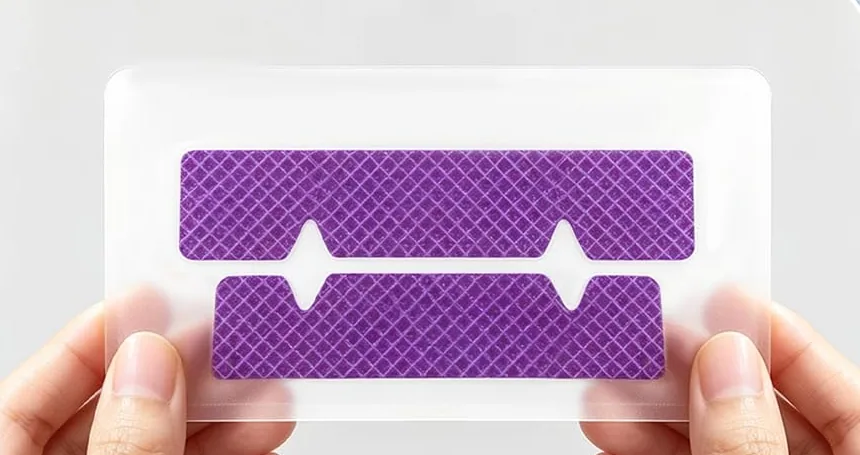
Small things make a session go better. Start with clean teeth. Press firmly, as the box says, from the middle of the smile outward, and keep the strip off the gums.
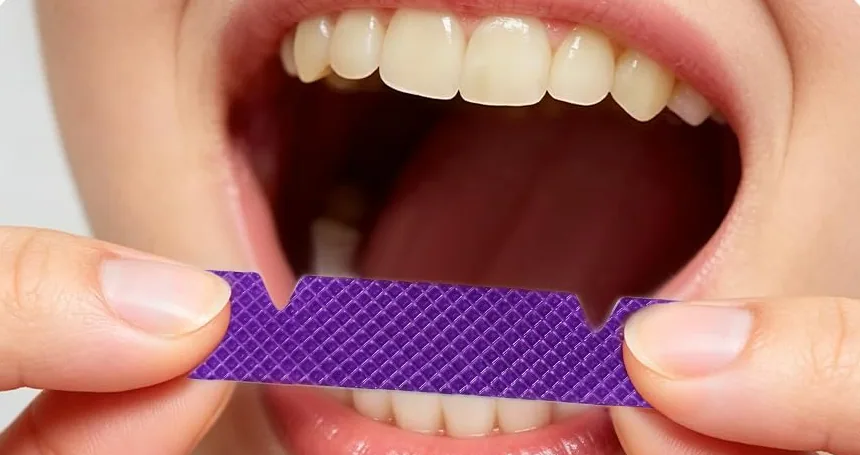
Then leave it alone. You can read, tidy up or watch something. Eating and drinking wait. When 30 minutes are up, peel the strips off, throw them away and rinse or brush away any gel that stayed behind. Set a timer. The box gives a number, and there is no gain in going past it.
The directions give a rhythm in two parts: once a day for 4 days in a row, then once a week. The product description also mentions steady use over 7 to 14 days for the best-looking result. Read together: a short daily start, then upkeep.
| Box | Sessions | Daily start | Weekly sessions after that | Weeks of upkeep in months |
|---|---|---|---|---|
| 28 strips | 14 | 4 days | 10 | About 2.3 |
| 56 strips | 28 | 4 days | 24 | About 5.5 |
The small box covers the start and 10 weekly sessions, which is about 2.3 months of upkeep. The large box stretches to about 5.5 months for one person, or gives two people a full course each. Mark the weekly day in your calendar, and pick an evening: nothing with coffee in it follows.
If you prefer the other reading, daily use for a week or two, the same box empties faster: 14 sessions are 14 days.
| When | Sessions | Sachets left in the box |
|---|---|---|
| Days 1 to 4 | 4, one a day | 10 |
| End of week 2 | 5 in total | 9 |
| End of week 3 | 6 in total | 8 |
| End of week 4 | 7 in total | 7 |
| End of week 8 | 11 in total | 3 |
| End of week 11 | 14 in total | 0 |
Upkeep is cheap to run once the start is done. One weekly session from the small box costs $2.14, or $1.61 from the large one. That is the whole weekly budget for the routine.
Two people can split a box. The box of 56 gives each of two people 14 sessions: the 4-day start and 10 weeks of upkeep. Keep the sachets sealed until the day of use, and nothing is lost by sharing.
The two boxes hold the same strips. The difference is the count and the price of one session.
| Box | Sachets | Price | Price of one session |
|---|---|---|---|
| 28 strips | 14 | $29.99 | $2.14 |
| 56 strips | 28 | $44.99 | $1.61 |
A session costs $2.14 in the small box and $1.61 in the large one. The large box asks for $15.00 more and doubles the sessions. Take the small box if these are your first PAP strips and you want to see how your teeth take them. Take the large box if you share with someone, or if a first box went well.
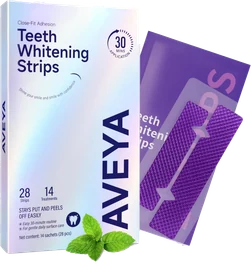
2 sizes: 14 treatments and 28 treatments
from $29.99 for 14 treatments, $2.14 a treatment
Strips are the middle of a ladder. The dental association's overview describes the rungs, from the mildest to the strongest.
| Option | How it works | Who runs it |
|---|---|---|
| Whitening toothpaste | Abrasives remove surface stains mechanically | You, while brushing |
| Over-the-counter strips and gels | Usually peroxide at lower concentrations | You, at home |
| Trays from the dentist | Gel with 10% to 38% carbamide peroxide in custom trays | You, with a dentist's supervision |
| In-office whitening | Gels with high peroxide concentrations | The dentist |
Teeth Whitening Strips belong on the second rung by format and differ from their neighbors by ingredient: PAP where the others use peroxide. Each step up the ladder brings a stronger agent and more supervision. Start low. If surface stains were the problem, a low rung is enough. If they were not, a dentist can tell you which higher rung fits.
It can. With peroxide whitening, sensitivity may start within 2 to 3 days and usually passes by the fourth day after the course ends. That is the dental association's summary of the research.
With whitening strip or tray-based treatments, sensitivity may develop within two to three days after starting the program and usually resolves by the fourth day post-treatment.
Sensitivity and sore gums are the two side effects dentists expect from whitening in general.
Temporary tooth sensitivity and gingival inflammation are the most common adverse effects of vital tooth whitening.
The box of AVEYA strips says for sensitive teeth, and PAP is its reason. The public evidence for that claim, so far, is the experience of early buyers. The first review on record speaks to exactly this point.
Delivers nice whitening effect really fast. The strips stay in place perfectly. I don’t get tooth sensitivity issues like other brands. Perfect for my weekly smile maintenance routine.
One review is one mouth. If your teeth sting or your gums turn white or sore during a session, take the strips off, rinse, and give it a few days. If it happens again, stop and ask a dentist. Keeping the strip off the gum line, and wiping away gel that squeezes onto the gums, helps a good deal.
The flavor is mint, and menthol is on the ingredient list for the cooling note. The strips are thin and flexible, with a grid pressed into the gel side. Once pressed on, they are meant to stay: the box says stays put, and the first buyer review agrees.
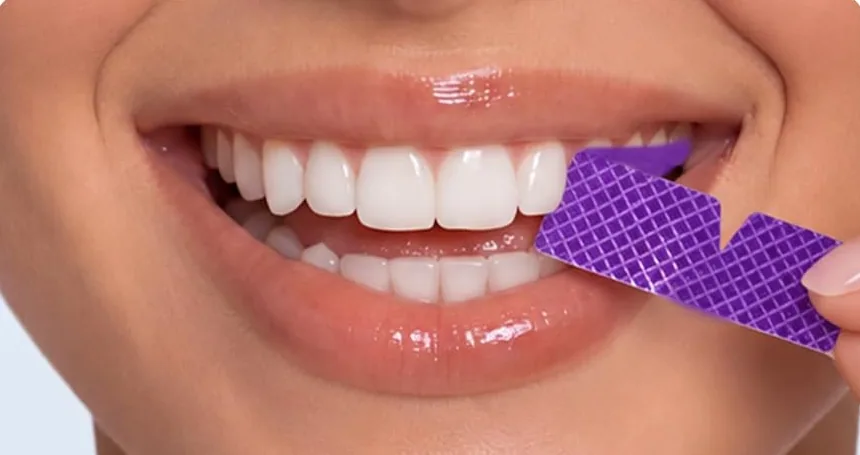
Talking is possible, if a little clumsy, so pick half an hour when nobody needs an answer from you. When the time is up the strips peel off easily, as the box puts it, and a rinse or a quick brush clears what is left of the gel.
A few situations call for a professional opinion before the first strip.
Crowns, veneers and fillings on front teeth. They do not change color.
Only natural teeth can be whitened, not tooth-colored restorations.
Natural teeth lighten and the restorations stay as they were, so the match your dentist made can come apart. Ask before you start.
Cavities, cracked teeth and gum disease. Gel can reach places it should not. Have these treated first.
Children and teenagers. The American Academy of Pediatric Dentistry, cited by the dental association, discourages full whitening for children and adolescents who still have baby teeth.
Braces. A strip cannot reach the enamel under a bracket, and the result would be patchy.
A dental exam before whitening has one more benefit: it tells you which kind of stain you have, and so whether strips are the right tool at all.
The dental association describes the exam that should come before bleaching, and the same logic holds before a box of strips. The dentist takes a health and dental history, asks what you think caused the discoloration, and asks about allergies.
Then comes the look. Existing restorations are identified and noted, because they will not change color. Cavities, cracks and gum problems are found before a gel can reach them. If the stains turn out to be the kind inside the tooth, you hear that before you spend money on the wrong tool.
A professional cleaning is on the association's list of things that reduce surface stains. Have it first and judge the color afterwards.
Strawberries with baking soda and charcoal with salt are the 2 home recipes the dental association's overview addresses, and neither comes out well. The cited research measured no improvement from the first, and the second wore enamel away and left a yellow cast.
| Recipe | What the cited research found |
|---|---|
| Strawberries with baking soda | No measurable improvement in color |
| Charcoal with table salt | Abrasive and ineffective, with enamel worn away |
The lesson carries beyond those two recipes. Scrubbing harder is not whitening. Enamel does not grow back, and the layer under it is yellower than the layer you are scrubbing off. A strip that sits still for 30 minutes is a gentler idea than anything gritty.
Surface stains come back, because the things that cause them are things people enjoy. The dental association names two things that make surface stains worse: poor oral hygiene and frequent dark drinks. So brush well, go easy on the refills, and keep the weekly strip going while the box lasts.
A whitening toothpaste can share the work. It scrubs surface stains off mechanically and does not bleach, which makes it a natural partner for the weeks between strips.
If the first three answers are yes, even, and recent, strips are a reasonable thing to try.
Not much yet. The strips went on sale in August 2026.
The first buyer review gives five stars and names three things: a fast effect, strips that stay in place, and no sensitivity. Read it as one early report, and read the next ones as they arrive.
The strips are the newest in the AVEYA family. The Snail Mucin Toner Pads are the face step: one of 100 soaked pads after cleansing. The Biotin Hair Growth Spray is the scalp step: about 1 ml, no rinse. The three can share an evening, since a strip session leaves your hands free for the other two.
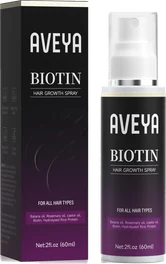
The other long reads: what is in the toner pads, and the spray's label, share by share.
Nothing here is dental advice. Whitening is cosmetic. See a dentist first if you have untreated cavities, gum disease or restorations on your front teeth.
Sources read for this guide
Skin
The ingredient list name by name, two ways to use a pad, and the people who should pass.
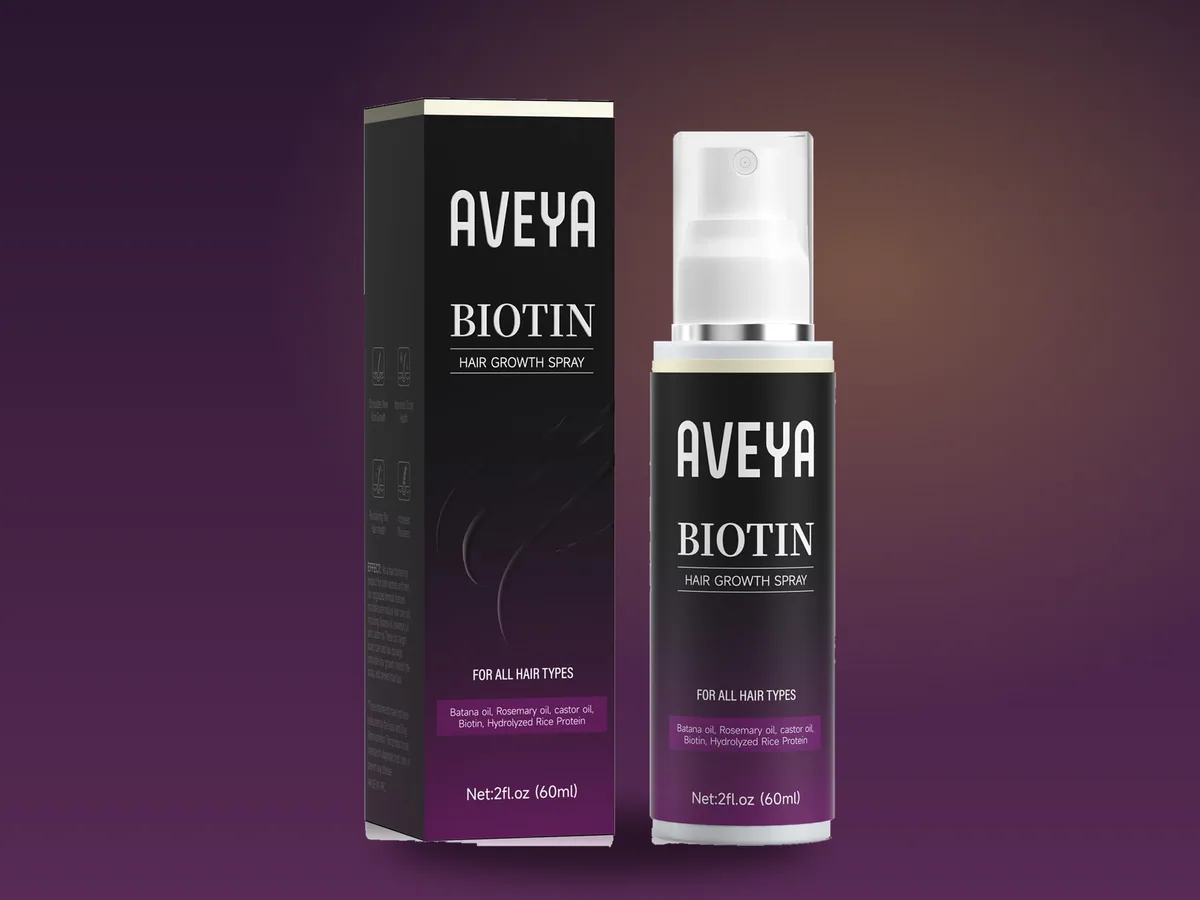
Hair
Every ingredient with its share, a bottle counted in days, and an honest look at what a scalp spray can do.